

Workplace conflict is inevitable. Relational breakdown doesn’t have to be.

THE REALITY OF WORKPLACE CONFLICT
Most organizations experience conflict. Few know how to resolve it effectively.
What typically happens:
- issues are avoided until they escalate
- conversations become reactive or unproductive
- leadership intervenes too late or without structure
- relationships fracture beyond easy repair
The result:
- loss of trust
- reduced productivity
- disengagement
- unnecessary turnover
DR. SILVA’S DISTINCT EDGE
Dr. Abigail Silva brings a rare depth to workplace mediation. With over three decades of experience across clinical, humanitarian, and organizational environments—including trauma response and high-stakes relational contexts—she has developed a refined ability to:
identify relational injury quickly
understand how people function under pressure
navigate complex emotional and interpersonal dynamics with precision
This depth allows her to work where many approaches fall short: at the intersection of human behavior, relational dynamics, and organizational function.
CORPORATE ATTACHMENT® IN CONFLICT
Conflict Is Patterned—Not Random
Through her Corporate Attachment® framework, Dr. Silva understands:
how individual attachment systems operate
how they interact under stress
how they create predictable cycles of conflict, withdrawal, or escalation
This provides adistinct advantage in mediation. Rather than addressing only what is being said, she identifies what is driving the interaction beneath the surface.
Because people don’t just argue about issues—they respond from relational patterns.
DR. SILVA'S SIGNATURE INTERVENTION - THE WRA MODEL
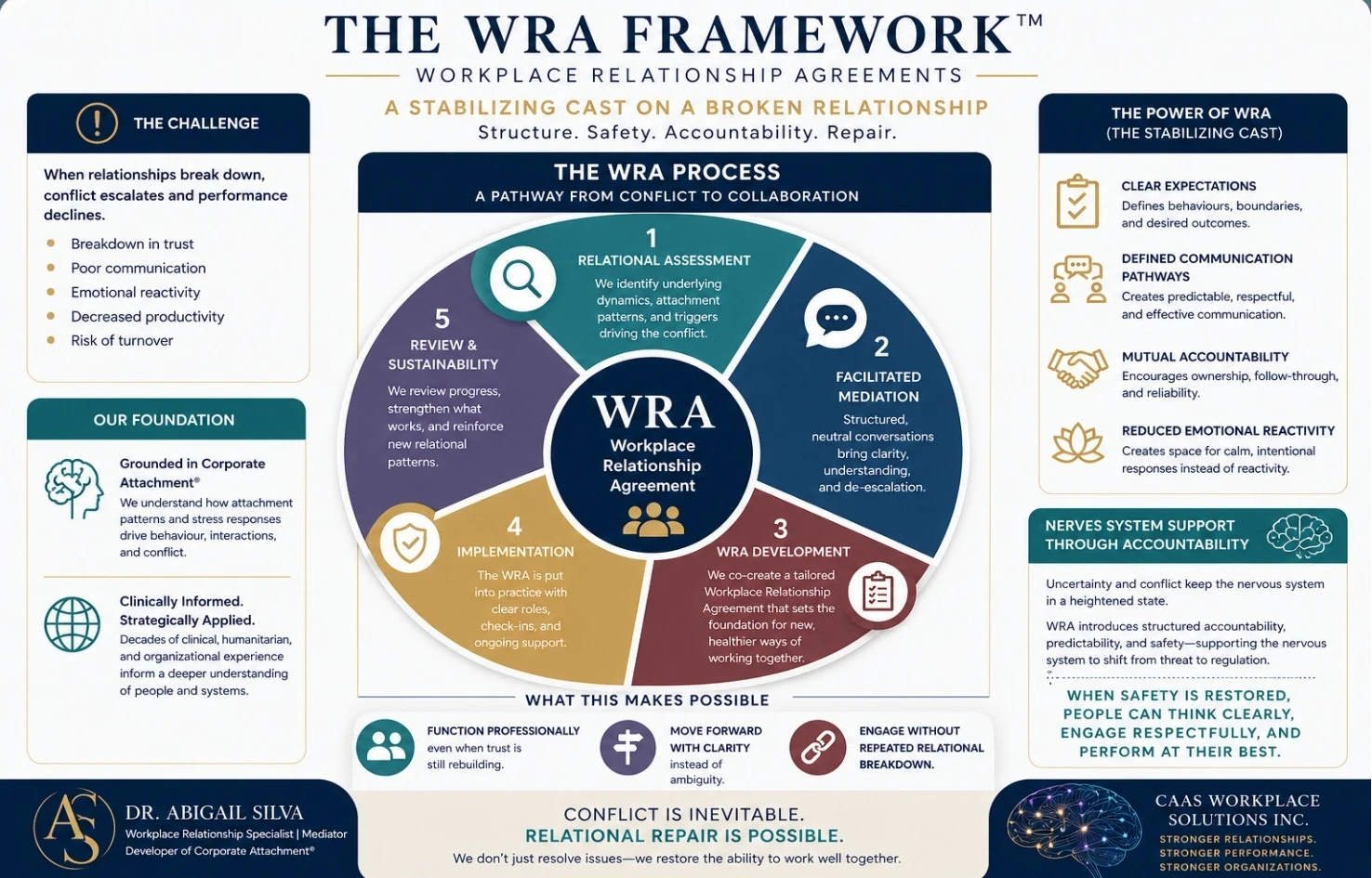
Workplace Relationship Agreements (WRA)
Dr. Silva's mediation process is built around her specialized model: Workplace Relationship Agreements (WRA)
A WRA functions as a stabilizing cast on a broken relationship.
It provides structure where instability exists by establishing:
-
clear expectations
-
defined communication pathways
-
mutual accountability
-
reduced emotional reactivity
Nervous System Support & Relational Safety
Relational conflict not only affects communication—it impacts the nervous system. When expectations are unclear, and interactions feel unpredictable, individuals often operate from:
-
heightened stress
-
defensiveness
-
withdrawal or escalation
A WRA introduces structured accountability, which does something critical: it restores a sense of safety
By making interactions:
-
predictable
-
boundaried
-
and clearly defined
The nervous system is supported to shift from reactivity → regulation.
This allows individuals to:
-
engage without constant threat perception
-
think more clearly
-
respond more intentionally
What This Makes Possible
With this structure in place, individuals are able to:
-
function professionally—even when trust is still rebuilding
-
move forward with clarity instead of ambiguity
-
engage without repeated relational breakdown
Over time, this supports the development of: healthier relational patterns that become the new standard of interaction.
WHAT MAKES THIS APPROACH DIFFERENT

Most mediation focuses on:
-
resolving the issue
-
reaching agreement
-
moving on
Dr. Silva’s approach focuses on:restoring relational function
By combining:
-
clinical insight
-
attachment-based understanding
-
structured relational agreements
She ensures that the relationship can work again, breaking the cycle of dysfunction and not just that the immediate issue is resolved.
ORGANIZATIONAL ADVANTAGE
This approach enables organizations to:
-
retain strong employees—even in conflict
-
reduce turnover caused by unresolved relational tension
-
restore productivity more quickly
-
create fair, structured pathways for conflict resolution
It creates outcomes that are: a win for both the organization and its people
WHEN TO ENGAGE MEDIATION
This work is most effective when:
-
conflict is ongoing or escalating
-
communication has broken down
-
trust is strained but roles must continue
-
leadership needs structured intervention
-
valuable employees are at risk of disengagement or exit
PROCESS
Dr. Silva’s mediation process includes:
1. Relational Assessment
Understanding the underlying dynamics and patterns at play
2. Facilitated Mediation
Structured conversation guided with clarity and precision
3. WRA Development
Creation of a tailored Workplace Relationship Agreement
4. Implementation & Follow-Through
Supporting the application of new relational practices
THE RESULT
When relational rupture is addressed effectively:
-
tension decreases
-
clarity increases
-
communication stabilizes
-
working relationships become functional again
And most importantly, the organization does not lose valuable people unnecessarily.